
Napkin plan
or deep dive:
the key decision at the start
Should you do in-depth research and a financial model at the startup pitching stage — or is a napkin plan with a general understanding of the market, wrapped in a good-looking presentation, enough?
Deep preparation at the start is needed — not for the presentation, but for two things: a 3–5-year benchmark and a red “stop” button. At the same time, a deep dive without limits slows down decisions. We choose solid preparation at the start with an element of intuition: the research and the model answer questions set in advance and end with a decision, not another round of analysis.
What a deep financial model gives you
A financial model at the start is not a spreadsheet for an investor. It is a tool that lets you:
- Clearly define the market perimeter — who exactly needs the product and in what volume, not “everyone who…”.
- Calculate unit economics — how much it costs to acquire a customer, how much they bring in and when they pay back.
- Understand the scaling logic — what needs to happen for the business to grow several-fold, and what it will cost.
- Move forward with a 3–5-year benchmark plan — check reality against the model and spot deviations before they become a crisis.
The red “stop” button
In-depth research has a second function that is talked about less often: it helps you see the red “stop” button. The key is to press it in time, without regretting the investment in a wrong hypothesis.
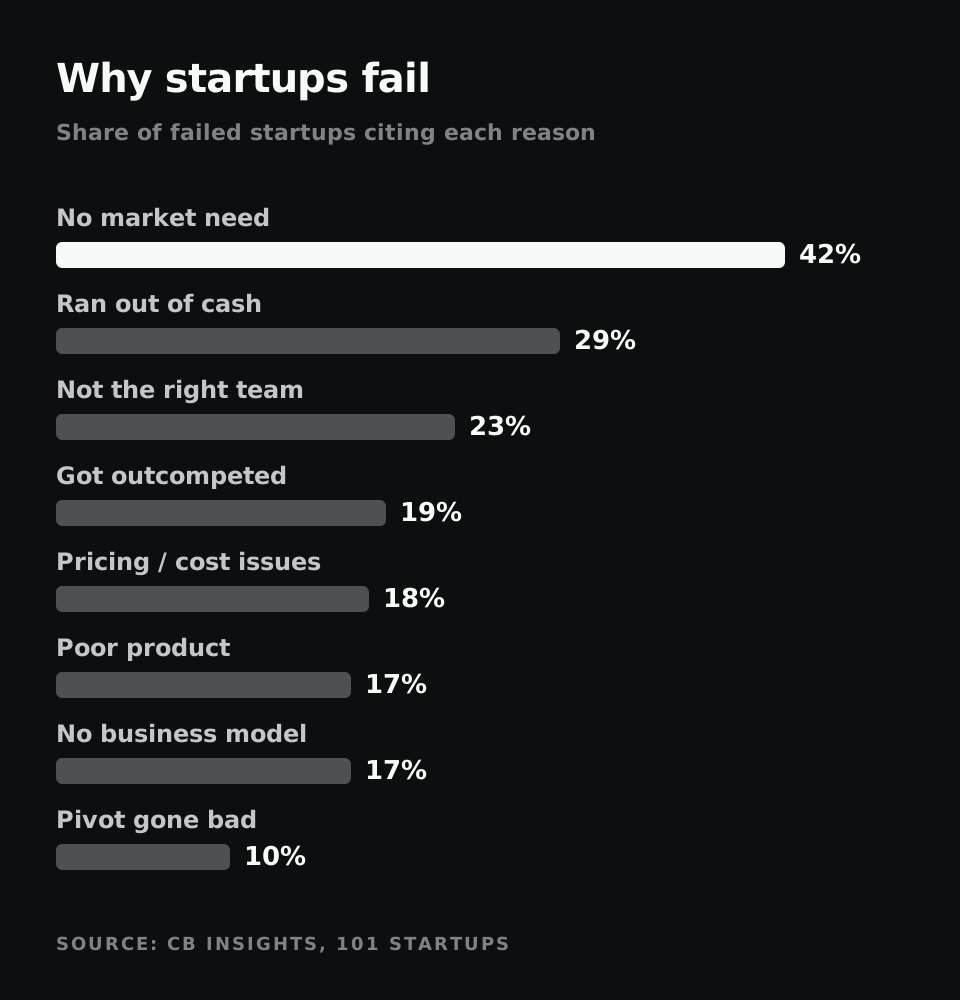
According to CB Insights, among the reasons startups shut down, “no market need” accounts for 42%, “no business model” for 17% and “pivot gone bad” for 10% of cases. At the research and modeling stage, this is visible in advance:
- Market need is tested by audience and demand research before launch, not after the first sales.
- The business model either works out in unit economics or it doesn’t — and the financial model shows this before the budget is spent.
- A pivot is easier when you have a model: you can see which assumptions were not confirmed and which way to turn.
The flip side of a deep dive
However, going into a deep dive and in-depth analytics stalls decisions and action. It forces you to think, doubt, choose between forks and invest money — and sometimes leaves founders paralyzed. Each new layer of data opens up new questions, and the moment when it’s time to act keeps getting pushed back.
| Napkin plan | Deep dive |
|---|---|
| A fast start and a good-looking presentation | Market perimeter, unit economics, 3–5-year plan |
| Hypotheses are tested with money after launch | Weak hypotheses are visible before investment |
| Risk: investing in a product the market doesn’t need | Risk: getting stuck in analysis and never starting |
How we strike the balance
We choose solid preparation at the start with an element of intuition. In practice, this means:
- Formulate in advance the questions the research must answer: is there a need, do the economics work, where is the market ceiling.
- Define “stop” criteria in advance — the numbers at which it is better to stop or pivot the idea.
- Limit the research by time, not by the amount of data. The decision is made at the end of that time — with what is known.
- Leave room for intuition where there is no data and cannot be. The model is a benchmark, not a guarantee.
You have to be able to accept mistakes
Sometimes solid preparation ends with a dissatisfied client and a “negative result”: the research shows that the idea won’t work in its current form. This is hard to hear, especially when time and effort have already been invested in the idea.
But you also have to be able to accept mistakes with gladness — for catching them in time. Stopping at the model stage costs incomparably less than stopping after launch.
At what stage did you realize that the decision to launch a product was not accurate?
If you are at the start
We will identify markets and industries for the new business, calculate the business model and product economics — and agree in advance at which numbers to press “stop”. You can start with a consultation — 90 minutes, €270.